




Our Bactador expert Lisa Peters and Prof. Dr. med. vet. Norbert Mencke show you what the possible causes may be and how to respond effectively. Proper cleaning with an enzyme cleaner from Bactador also plays a crucial role in preventing the behavior from becoming ingrained.
- Why does my dog mark inside the house? The veterinarian explains
- Medical reasons for involuntary urination – When you should see the veterinarian
- Difference: Marking vs. house soiling in dogs
- Training and everyday tips: What you can do about marking
- Removing odors deep within fibers: How to use Bactador enzyme cleaners correctly
- Conclusion
- Frequently asked questions
Marking is not a sign of disobedience, but a natural communication behavior in which your dog conveys information using scents.
Stress and changes in everyday life are among the most common triggers and can lead to your dog marking more frequently.
Medical causes should always be ruled out, especially if your dog suddenly urinates or marks inside the house.
Odors must be completely removed, otherwise they will remain detectable to dogs: with the Bactador enzyme cleaner, you can permanently eliminate the source of the odor.
Training and fixed routines give your dog security and help reduce marking behavior in the long term.
Why does my dog mark inside the house? The veterinarian explains
Our consultant and veterinarian Prof. Dr. med. vet. Norbert Mencke explains that dogs communicate using urine. Scents and pheromones in dog urine serve to leave information for fellow dogs. So, if your dog marks inside the house, it is initially a normal behavior, even if it is problematic in your everyday life.

Hormonal, psychological and social triggers
Marking occurs particularly frequently during the puberty of young dogs. But adult dogs also exhibit this behavior when certain stimuli are present.
Typical causes are other dogs in the household, hormonal influences, or your dog's insecurity.
If several dogs live together, marking can also be a form of social communication. Your dog deliberately leaves scent marks to show its place in the group or to react to the scents of the other dogs. Especially when the dynamics in the pack change, for example due to a new dog or competition for resources such as food, sleeping places, or attention, marking behavior can intensify. Subtle tensions between the dogs are sometimes enough to trigger this behavior. The situation may seem calm to you, while your dogs perceive very precisely who is where and what scents are present. In such cases, it helps to establish clear structures and offer individual retreat areas. In addition, it is important to consistently remove existing scent trails, even deep into floors, carpets, or mats, with an enzyme cleaner, so that the behavior does not become further ingrained.

Permanent odor removal through Bactador microbiology
Reliable against the most stubborn odors such as vomit, sweat, or urine
The alternative to chemical cleaners
Especially with female dogs, the cycle also plays an important role: During heat, the hormone level changes significantly, which can lead to female dogs marking their surroundings more frequently. Also in the phase afterwards, especially in the case of a false pregnancy, changes in behavior and noticeable marking behavior often occur. Many female dogs appear more sensitive or restless during this time, or show nesting behavior. Marking can be an expression of this internal hormonal change.
Also emotional factors play a role for dogs: boredom, understimulation, separation stress, or insecurity in everyday life can lead to your dog marking more frequently. In these cases, the behavior often serves to relieve stress or calm yourself.

Sudden changes such as stress as a trigger
If your dog suddenly marks inside the house, there is often a change or a form of stress behind it. Dogs are creatures of habit and react very sensitively to changes in their environment, even when these seem less important to us humans.
Typical stress triggers are, for example
- a move,
- new furniture,
- a changed daily routine.
- new family members such as babies,
- frequent or restless visitors,
- another pet
All these factors can trigger insecurity. Your dog has to reorient itself in such situations and often processes this change through its behavior, including marking.
An often underestimated factor is foreign scents. The sense of smell plays a central role for dogs. If you bring new scents home, for example from other dogs on your clothes or shoes, your dog may react by marking itself to leave "its own scent trail". Similarly, old urine residues that have not been completely removed can lead to your dog marking the same spot again and again.
That is exactly why, in addition to training, proper cleaning is crucial. If urine or marking odors persist, your dog's behavior often intensifies. The odor remover from Bactador helps to completely remove these odor sources and take away your dog's orientation to old marking spots. This is done using microbiology based on natural enzymes, which break down the odor particles until they are completely and thus permanently eliminated.

Medical reasons for involuntary urination – When you should see the veterinarian
Veterinarian Prof. Dr. med. vet. Norbert Mencke points out that physical causes can also be behind frequent and involuntary urination. In addition to inflammation in the urogenital tract, hormonal imbalances play an important role. An imbalance in the hormone household (for example due to castration, age, or diseases and changes in the ovaries and testicles) can lead to reduced bladder control or increased frequent, often involuntary urination.
What diseases can be triggers?
Possible causes for increased urination include, for example, urinary tract infections or bladder infections, which are often accompanied by an increased urge to urinate. Hormonally caused diseases such as diabetes mellitus or Cushing's syndrome (a hormonal disease in which the body permanently produces too much cortisol, leading to increased drinking and urination, among other things) also often lead to noticeable changes in behavior.
Another symptom that is often confused with marking is incontinence, i.e., the involuntary, uncontrolled loss of urine. Unlike marking, where your dog deliberately lets out small amounts, with incontinence, he has no control over the flow. This is often shown by damp sleeping places, dripping when getting up, or wet spots without any apparent reason. Especially in the older dog, a decline in bladder control can occur, triggered by aging processes, hormonal changes, or neurological diseases. Spayed female dogs are also more frequently affected due to the drop in estrogen. Incontinence is not a behavioral problem and should always be treated by a veterinarian.
Regardless of the cause, however: urine residues on sleeping places, floors, or cushions should be thoroughly and permanently removed. The odor and stain remover from Bactador removes the odor source deep within the fibers, while being gentle on materials and suitable for your dog's environment.
Difference: Marking vs. house soiling in dogs
Marking and house soiling are often confused. With marking, your dog deliberately lets out small amounts, often on furniture or walls. With house soiling, he completely empties his bladder.
Both variants leave odors that remain detectable to dogs despite superficial wiping. Even if you initially smell nothing after a seemingly successful cleaning with chemical products or popular household remedies such as vinegar or baking soda, the scent information remains for your dog. It is better to reach for the enzyme cleaner from Bactador, because it completely and permanently removes the odor source and thus prevents marking from happening again.

Training and everyday tips: What you can do about marking
A structured everyday life helps your dog develop security. Fixed routines, clear rules, and sufficient exercise reduce the stress that many dogs experience in everyday life.
It is important that you lead your dog calmly and consistently. If you notice that he is heading for a spot to mark, you can redirect him early, for example with a stop signal or by leading him away from the situation. If your dog shows desired behavior, you should reward it specifically, so that he learns what is expected of him.

“The stop signal is one of the most important commands for me in everyday life with a dog, also on the topic of marking. When I notice that Pepper is about to start, I say my stop signal calmly and clearly, for example ‘Leave it’ or ‘Stop’, and immediately redirect her. If she follows, she gets praise.”
Important: The stop signal only works if it was established beforehand, preferably when the dog is still a puppy, in calm situations, never under pressure, never as punishment. The dog should not be frightened, but voluntarily redirect, because he knows that it is worth it. With a little practice, this will become a real routine.
The handling of already marked spots is just as crucial: clean them as soon as possible and thoroughly, so that the odor does not become ingrained. If residues remain in the material, your dog will very likely visit the spot again. The microbiological enzyme cleaner from Bactador removes the odor source deep within the surface (e.g. floors, tiles, carpets, cushions), so that even your dog's sensitive nose no longer perceives the odor and therefore is not attracted back to marking.
Dog marks in other people's houses – territorial behavior on the go
Some dogs also mark in other people's houses, even though they have long been house-trained at home. The reason for this is often a combination of foreign scents and insecurity. For your dog, a new environment is full of unknown scent information, which encourages him to leave his own scent mark.
How you can prevent excessive marking on the go
Especially in other people's houses, it helps to give your dog orientation from the beginning and make the entry as stress-free as possible. A short walk before the visit ensures that your dog is already relaxed and has been able to relieve himself. This reduces the probability that he urinates or marks directly in the new environment.
A calm arrival is also crucial: Let your dog explore the surroundings first under controlled conditions by your side and give him time to orient himself. Clear, calm signals help you to interrupt unwanted behavior early without building up additional pressure.
“I always go for another big walk with Pepper before visits. This reduces stress and prevents marking.”
In addition, if possible odor sources have been removed deep within the fibers beforehand with the Bactador odor and stain remover, the environment loses its “marking appeal” for your dog.

Removing odors deep within fibers: How to use Bactador enzyme cleaners correctly
Dog urine smells so intense because it consists of various organic components that decompose in the air and penetrate deep into materials. It is precisely these residues that cause the unpleasant odor over and over again, even when the surface already appears clean.
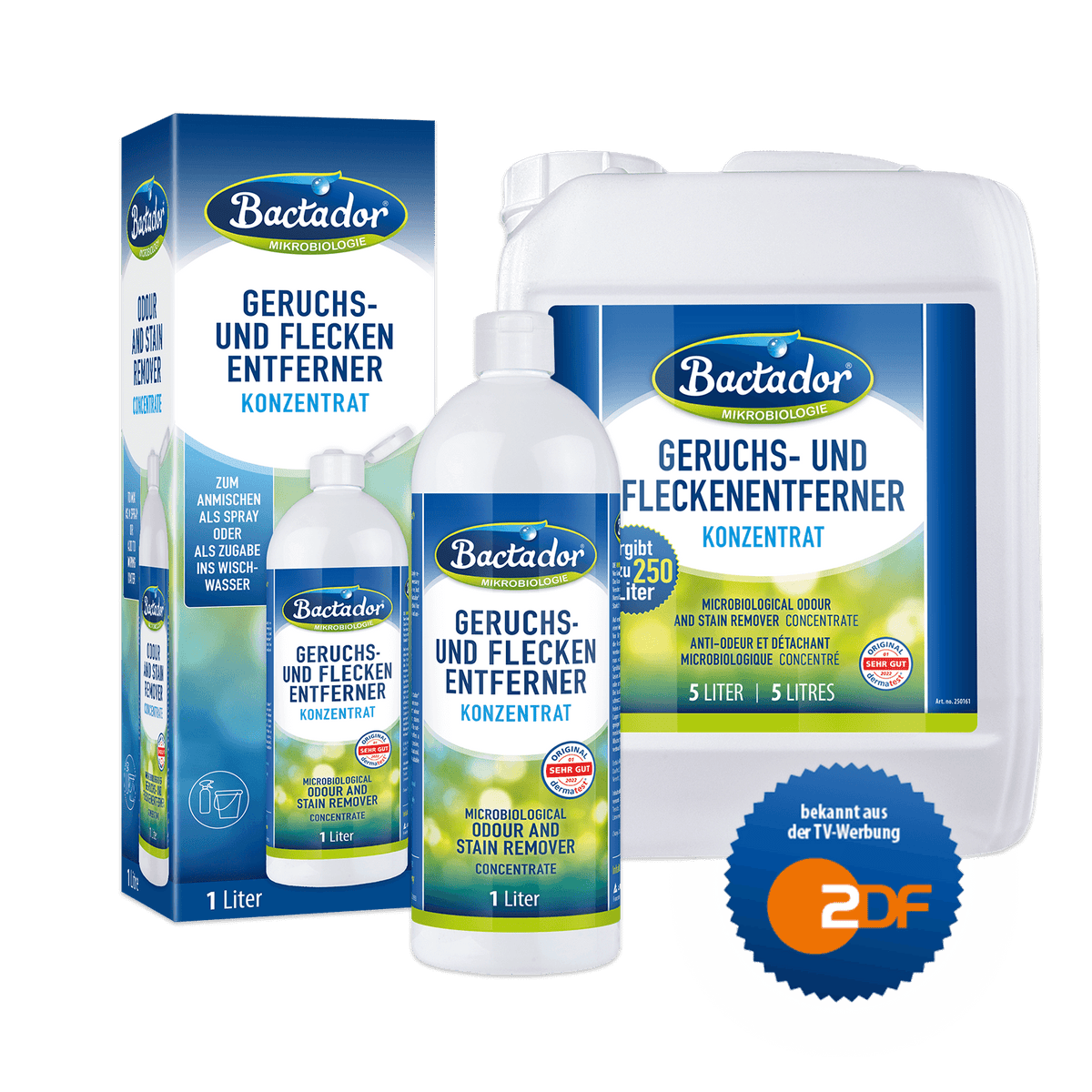
The odor and stain remover by Bactador addresses exactly this: Through the included microorganisms, natural enzymes are formed that break down the organic residues of the urine step by step until the actual source of the odor is completely removed.
This is how you should proceed when applying it:
- First, you should carefully absorb fresh urine or large stains with an absorbent cloth. It is important not to rub, so that the urine does not spread even deeper into the material.
- Next, the bottle of Bactador enzyme cleaner should be shaken well, so that the microbiological components can activate and distribute optimally.
- Then spray the affected area generously. Make sure not only to treat the visible surface, but also the edges, as odors often spread further than you can see at first glance. The material should be well moistened so that the Bactador enzyme cleaner can work deep down.
- In the final step, simply let the treated area air dry. It is important not to wipe it off and not to use any additional cleaners, as these can impair the microbiological effect. During the drying process, the enzymes continue to work and completely break down the source of the odor.
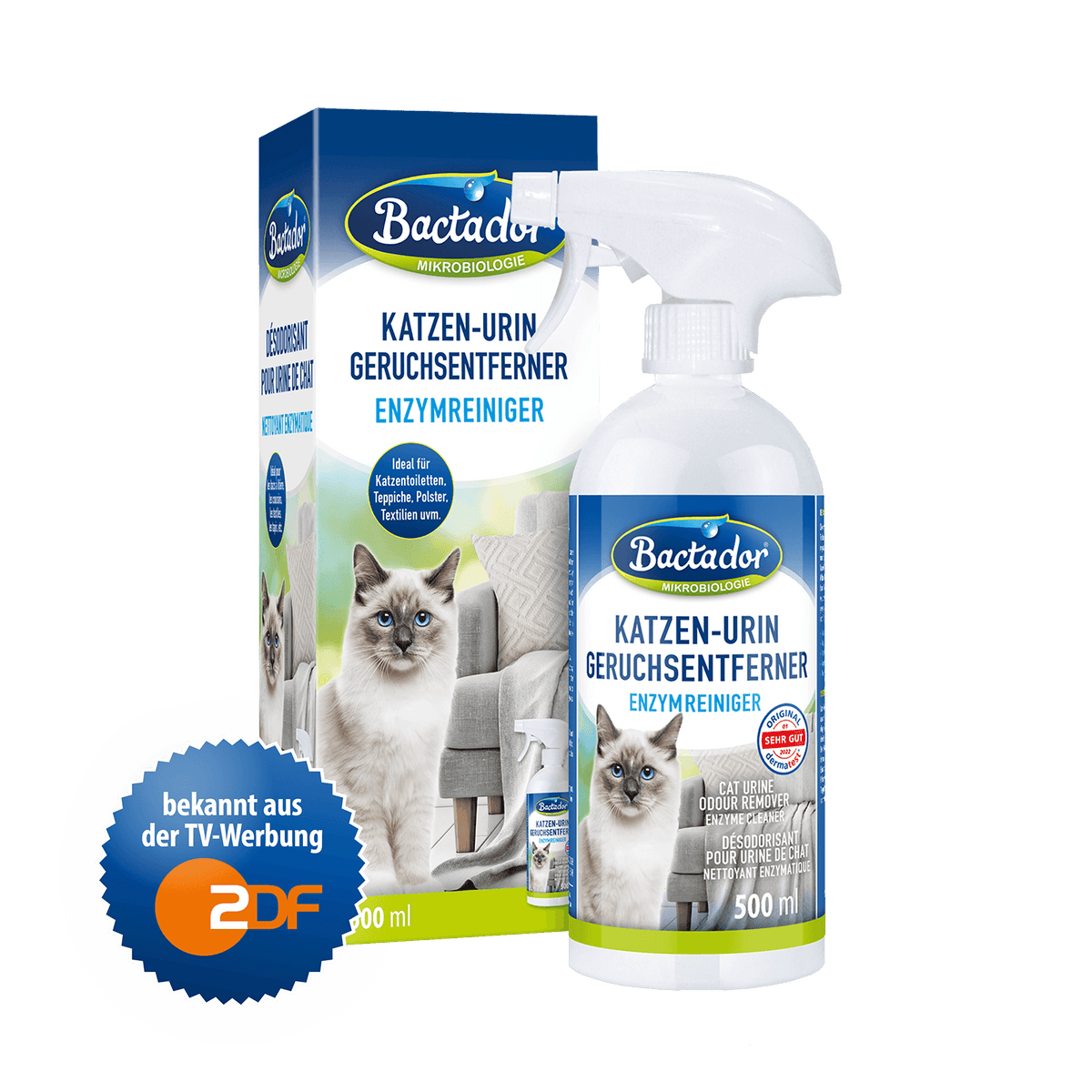
- For different areas of use, Bactador offers suitable solutions: The spray is ideal for localized stains on carpets, upholstery, furniture, and walls, so exactly where dogs mark most often.
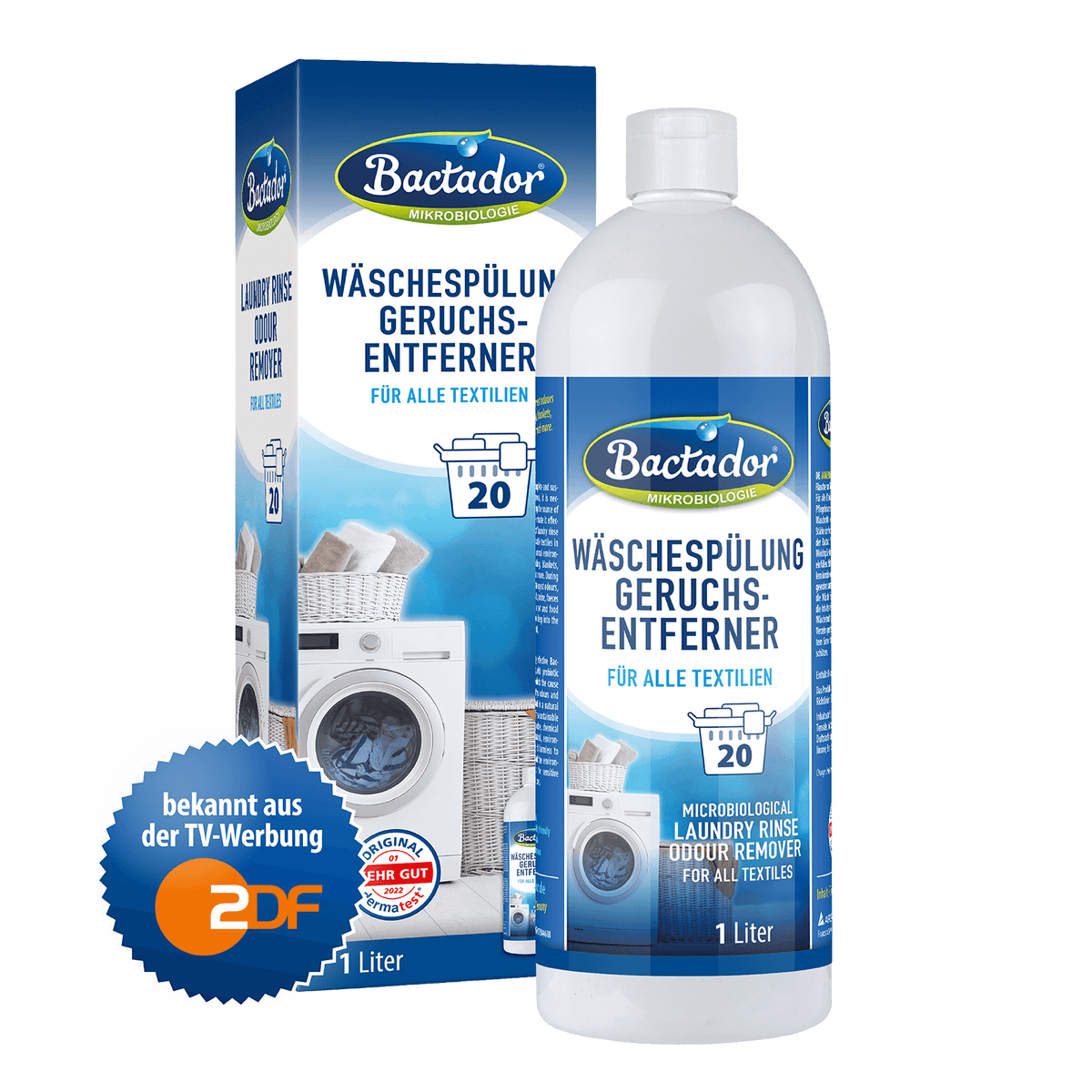
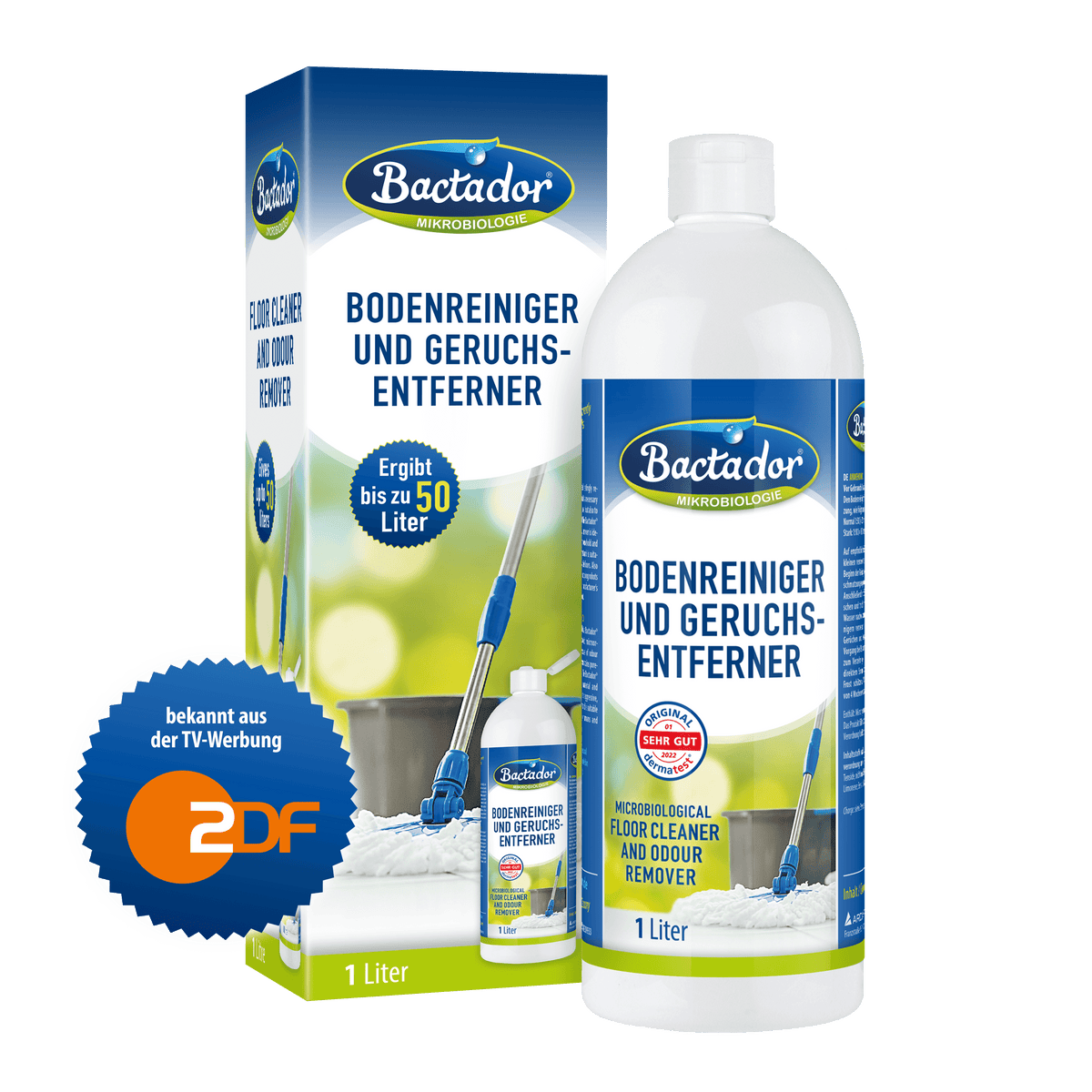
For larger areas such as floors, the Bactador floor cleaner is a good choice, while the Bactador fabric softener can be used specifically for washable textiles such as blankets or dog beds.
Conclusion
If your dog marks in the house, you should carefully consider the causes. Often, stress, hormonal influences, or changes in the environment play a role. However, sudden urination should always be checked by a veterinarian first. No dog marks out of malice: He is communicating. The better you understand what is behind it, the more targeted you can react.
With training, patience, and the right cleaning, you can sustainably influence the behavior of your four-legged friend. As long as your dog perceives his own scent trails, even if you can no longer smell anything, the urge to mark again in the same place remains for him. The microbiological products by Bactador remove urine odors deep into the fibers permanently, odor-forming molecules in the material are microbiologically broken down, thus taking away the olfactory basis for marking behavior.
Frequently Asked Questions
How do I distinguish marking from accidents?
When marking, your dog deliberately deposits small amounts of urine in specific places, usually on vertical surfaces such as furniture or walls. An accident, on the other hand, means a complete bladder emptying, often on the floor and without a visible target. In practice, this distinction is important because the causes are different. However, in both cases, you should make sure to remove the odors completely. The enzyme cleaner by Bactador ensures that no odor residues remain that could attract your dog again.
My dog was housebroken – why is he suddenly marking?
If a previously housebroken dog suddenly starts marking, there is usually a change behind it. This can be stress, a move, new housemates, or also a health problem. Dogs react very sensitively to their environment and often use marking as a vent for insecurity. It is important to stay calm, identify the cause, and additionally treat the affected areas thoroughly with the odor and stain remover by Bactador, so that the odor is not only temporarily covered up, but permanently removed.
Can I prevent my dog from marking by neutering?
Neutering is not a general solution for marking behavior and should not be considered too hastily. Whether hormonal factors play a role can only be assessed individually with advice from the veterinarian. However, the causes are often stress, insecurity, or learned behavioral patterns. Therefore, it is more sensible to first analyze the triggers in everyday life and work specifically on them. In addition, consistent cleaning with the products by Bactador helps, so that existing marking spots are no longer perceptible and thus lose their appeal.
Which training methods help my dog stop marking?
The most effective method is a combination of clear structure, positive reinforcement, and stress reduction. Your dog should learn where marking is allowed and where it is not, without punishment, but through your targeted guidance. Commands such as "Go on" and a trained stop signal like "Stop" can help interrupt unwanted behavior. In addition, it is crucial to treat old marking spots in the house with the enzyme cleaner by Bactador, so that your dog does not perceive these places as a "marking spot" again.
How do I permanently remove the urine odors from marking from my house?
Urine penetrates deep into materials and can still be perceptible even after cleaning, especially to the sensitive dog nose. Conventional cleaners or household remedies often only cover the odor for a short time. The microbiology by Bactador breaks down the organic components of the urine and completely removes the source of the odor. This prevents your dog from perceiving the same spot again and marking it.
Is Bactador suitable for my pet's environment?
Yes, Bactador was specially developed for use in households with animals. The microbiological mode of action is gentle on materials and skin and is suitable for many surfaces such as carpets, upholstery, or floors. You can use the Bactador enzyme cleaner specifically where unpleasant odors are caused by urine, feces, dirt, or also vomit, without having to use aggressive ingredients. This makes it a practical solution and a must-have for everyday life with a dog.