
Whether this really helps and what you can do instead is explained by Bactador expert Lisa Peters, supplemented by the professional assessment of Prof. Dr. med. vet. Norbert Mencke. In this article, we consider whether cat urine can be removed with home remedies and show what really helps to remove the odor permanently.
- Why do cats pee outside the litter box? What the vet says
- Immediate help for fresh cat urine: Are home remedies useful here?
- Remove dried cat urine with home remedies?
- Remove cat urine permanently with enzyme cleaners: How it really works
- Conclusion
- Frequently asked questions
Cat urine contains urea, uric acid, creatinine, and pheromones: This combination makes the odor so extraordinarily persistent.
Home remedies such as vinegar, baking soda, or dish soap can superficially and temporarily mask the fresh urine odor, but do not remove the odor source in the fiber.
Dried cat urine can practically not be removed permanently with home remedies. Uric acid crystals anchor themselves deep in fibers and pores.
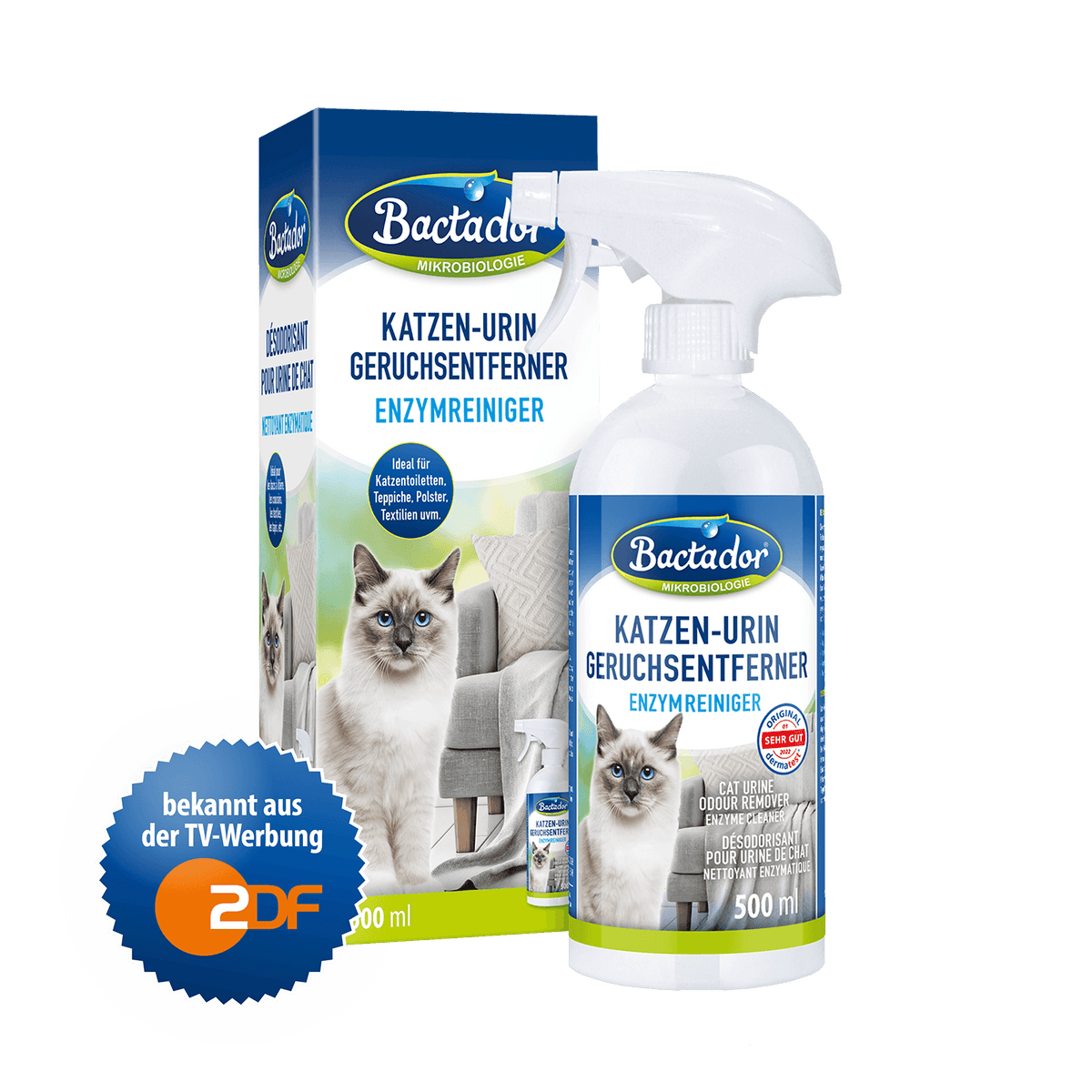
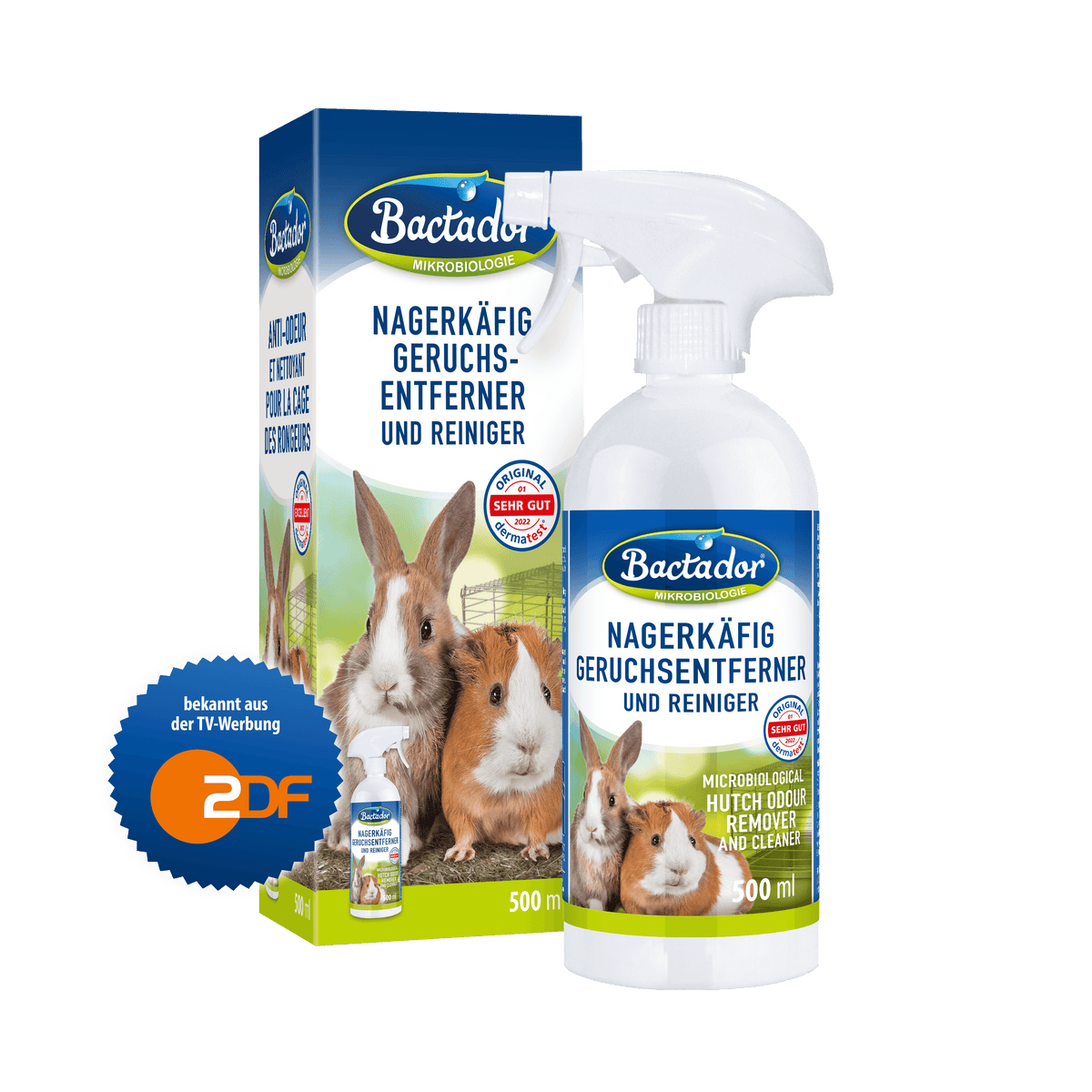
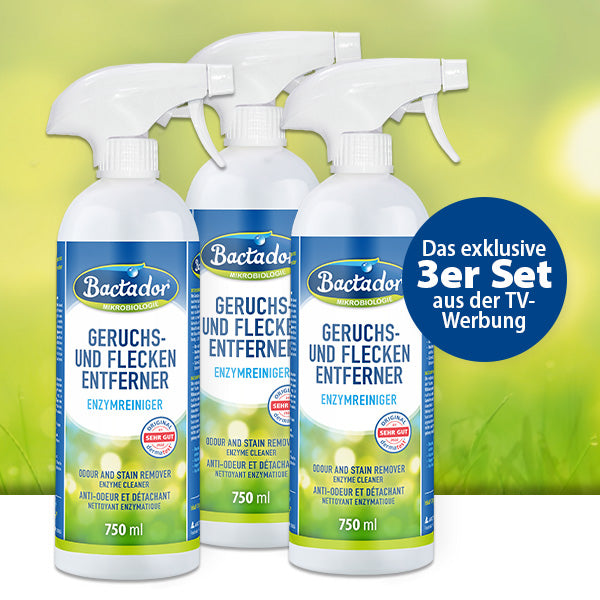
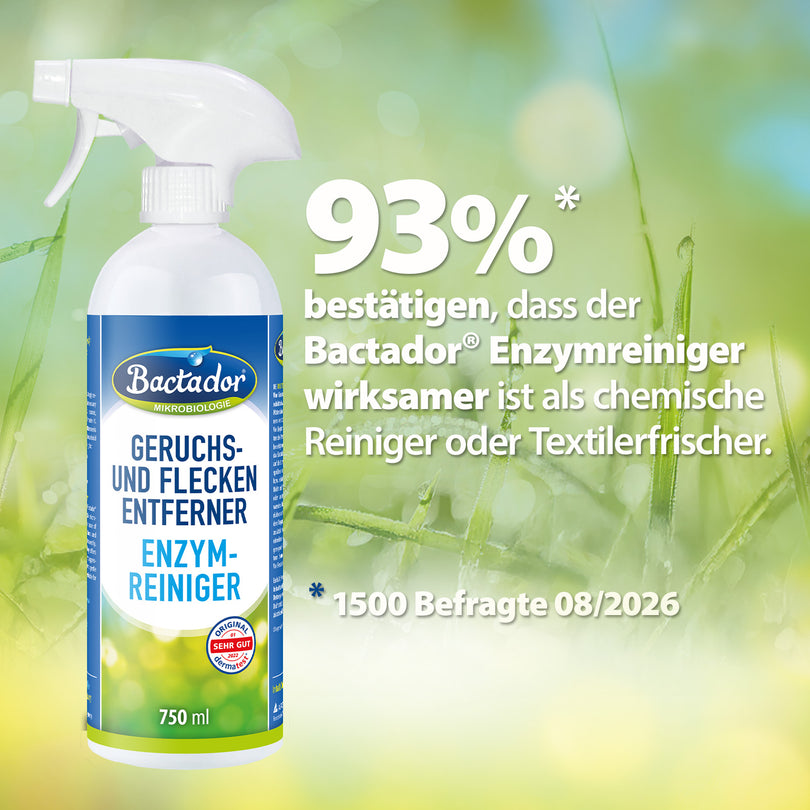
Enzyme cleaners such as the Bactador Cat Urine Odor Remover work on a microbiological level and permanently neutralize odor particles down to the deepest fibers, without merely masking the odor source.
Avoid vinegar and alcohol at marking spots: Home remedies can intensify the odor and further stimulate the cat's marking behavior.
Why do cats pee outside the litter box? What the vet says
Before you start treating stains, it is worth taking a brief look at the cause. Because not every puddle outside the litter box has the same background. The difference between incontinence and urination marking is crucial here and also influences how you should proceed.
Incontinence is often caused by medical issues. Bladder infections, bladder stones, kidney problems, diabetes, or age-related incontinence can lead to your cat no longer reaching the litter box in time. If your cat suddenly pees outside the litter box, a veterinary examination is therefore recommended first to rule out health causes.
Urination marking, on the other hand, is territorial behavior that occurs particularly frequently in unneutered or stressed cats. Here, cats deliberately deposit small amounts of urine on vertical surfaces, sometimes also on flat surfaces. Typical behavioral triggers are stress, changes in the household, territorial competition with other animals, or an inadequate litter box situation (location, cleanliness, number of litter boxes).
Important in both cases: Marking and accident spots will continue to attract the cat as long as the odor is not completely removed. Even traces that humans no longer perceive are still recognized by your cat's sensitive nose and interpreted as a signal to urinate there again.

Immediate help for fresh cat urine: Are home remedies useful here?
If your cat has just freshly peed, you should ideally react as quickly as possible. Blot as much liquid as possible with an absorbent cloth. Do not rub under any circumstances, as this only spreads the urine deeper into the fiber. This first mechanical step is important and works regardless of what you use to clean up afterwards.
Home remedies such as vinegar, baking soda, or dish soap can indeed clean the surface at this moment and make the stain visibly lighter, but often also damage materials. What remains, however, are organic residues that settle deep into textiles and floors. Cat urine consists of water, urea, urobilin, uric acid, creatinine, ammonia, and pheromones. This combination explains the extreme odor. It is simply not possible for home remedies to reach the odor source deep within the fibers.

“I myself experimented with vinegar and baking soda for a long time before I understood why the odor kept coming back. Home remedies can at best clean the surface, but cat urine penetrates much deeper into the material than you can see. You only notice the difference once you have used a product that really penetrates the fiber and ensures that the odor really does not return after a while.”
Vinegar and water
Vinegar is the first choice in many households. The slightly acidic pH value can superficially dissolve alkaline urine residues. What many do not know: The vinegar's own odor only temporarily masks the urine odor, it does not neutralize it. As soon as the vinegar evaporates, the typical cat urine odor returns.

Permanent odor removal through Bactador microbiology
Reliable for the most stubborn odors in the cat environment (urine, feces, vomit, etc.)
The alternative to chemical cleaners
Dish soap-water solution
A mixture of dish soap and water can lighten the visible pee stain and help dissolve dirt residues. However, it cannot reach deeply embedded odor particles. Particular caution is required with natural textiles such as wool or with microfiber, as dish soap can damage the material. Furthermore, dish soap residues in the carpet can attract new dirt and lead to yellowing.
h3>Baking powder or baking sodaBaking powder is probably the most popular supposed home remedy against cat urine odor. It superficially binds moisture and temporarily masks the odor. However, baking powder and baking soda are not permanently effective: The organic residues that cause the typical pungent odor remain deep in the fiber and are not reached by baking soda or baking powder. The effect is purely physical, a chemical neutralization of the odor molecules does not take place.
Another important note: If you rub baking soda into a fresh urine stain, the urine is rubbed deeper into the fiber. Furthermore, baking soda residues can remain in the carpet and bleach the colors of your carpet.
At places where your cat has marked, you should rather refrain from home remedies. The foreign odor, especially from vinegar, can prompt the cat to mark the spot again. Anyone who has a cat at home is much better advised with the special Bactador Cat Urine Odor Remover: It belongs in the basic equipment for cat owners just as much as kitchen paper and is made exactly for such situations.
Remove dried cat urine with home remedies?
Once cat urine has dried, cleaning becomes significantly more difficult. The water has evaporated, but the uric acid crystals have anchored themselves deep in the fibers and pores. And that is exactly what explains why the odor suddenly returns when it gets warm or damp: The crystals release volatile odor molecules when exposed to moisture. The room then smells like cat urine again, even though you had already cleaned it.
Home remedies simply cannot reach these embedded structures. Vinegar, baking soda, and dish soap cannot penetrate deep enough chemically or mechanically to dissolve them. Anyone who really wants to remove old cat urine odor needs a solution that penetrates deep into the material at the fiber level.

“Uric acid anchors itself deep in porous materials when it dries. Simple home remedies can neither chemically nor mechanically dissolve these bonds. A microbiological solution is needed that directly addresses the odor source.”
Good to know: With a UV blacklight flashlight, old, already dried urine stains can be made visible. They typically fluoresce in a blue-green shade. This way you can also find spots that you may have forgotten or even not noticed. This is particularly practical when moving into a new apartment or after buying used furniture.

Remove cat urine permanently with enzyme cleaners: How it really works
Enzyme cleaners are often recommended as the solution to cat urine, and for good reason. They contain active ingredients that break down organic odor particles on a molecular level. Bactador works on a microbiological basis: The microorganisms contained are activated, produce natural enzymes and break down the organic dirt and odor particles of the urine as long as the odor source is removed down to the deepest fibers of floors, cushions, carpets, or textiles. The result is a real, permanent odor removal without temporary masking.
“At our home, an old cat urine stain on the carpet kept coming back for months, no matter what I tried. Since I know Bactador, that is no longer an issue. After drying, the odor was simply gone. Not masked, but really gone.”
Bactador is particularly gentle on materials and skin and is also recommended by veterinarians.

Material-specific cleaning: How to properly treat carpet, couch, mattress, and cushions
Depending on where or what material you want to remove the cat urine odor from, the procedure differs slightly. The basic principle, however, always remains the same: locate the odor source, treat generously with Bactador, let dry completely.
How you proceed with the Bactador Cat Urine Odor Remover:
- Blot fresh urine: Blot as much liquid as possible with absorbent kitchen paper or a cloth. Do not rub.
- Shake the bottle: Before spraying, shake the Bactador bottle vigorously so that the microorganisms are optimally activated and distributed.
- Spray generously: Spray the Bactador Cat Urine Odor Remover evenly and generously on the affected area. Also include the invisible edge areas so that the odor source is completely reached.
- Let dry: Simply let the treated area dry in the air. No dryer, no wiping, no other cleaners. If you wipe off too early or rinse with water, you interrupt the microbiological process and reduce the effect. The microorganisms work while the area is still damp and slowly dries. Until the odor is completely removed.
- For stubborn or old odors: You can repeat the application using the same principle if the odor is still slightly noticeable after drying.
Further notes
- Test on water-sensitive materials beforehand: Check at an inconspicuous spot whether the material is water-resistant (e.g., untreated leather, certain natural fibers).
- Exposure time: There is no blanket exposure time, as it depends on, for example, the intensity, timing, and material: The treated area simply must dry completely.
- For mattresses: Remove the sheet and protective cover and wash separately if possible. The Bactador Fabric Softener is ideal for this. Spray the mattress intensively with the Bactador Cat Urine Odor Remover so that the enzymes can penetrate deep into the core.
Effective floor cleaning
Floors look clean after a quick wipe, but the odor often remains anyway. Especially in the joints and small cracks between tiles or floorboards, cat urine can settle in so-called urine depots. Classic floor cleaners mask the urine odor for a short time, but do not combat it at the source, so it returns after a while.
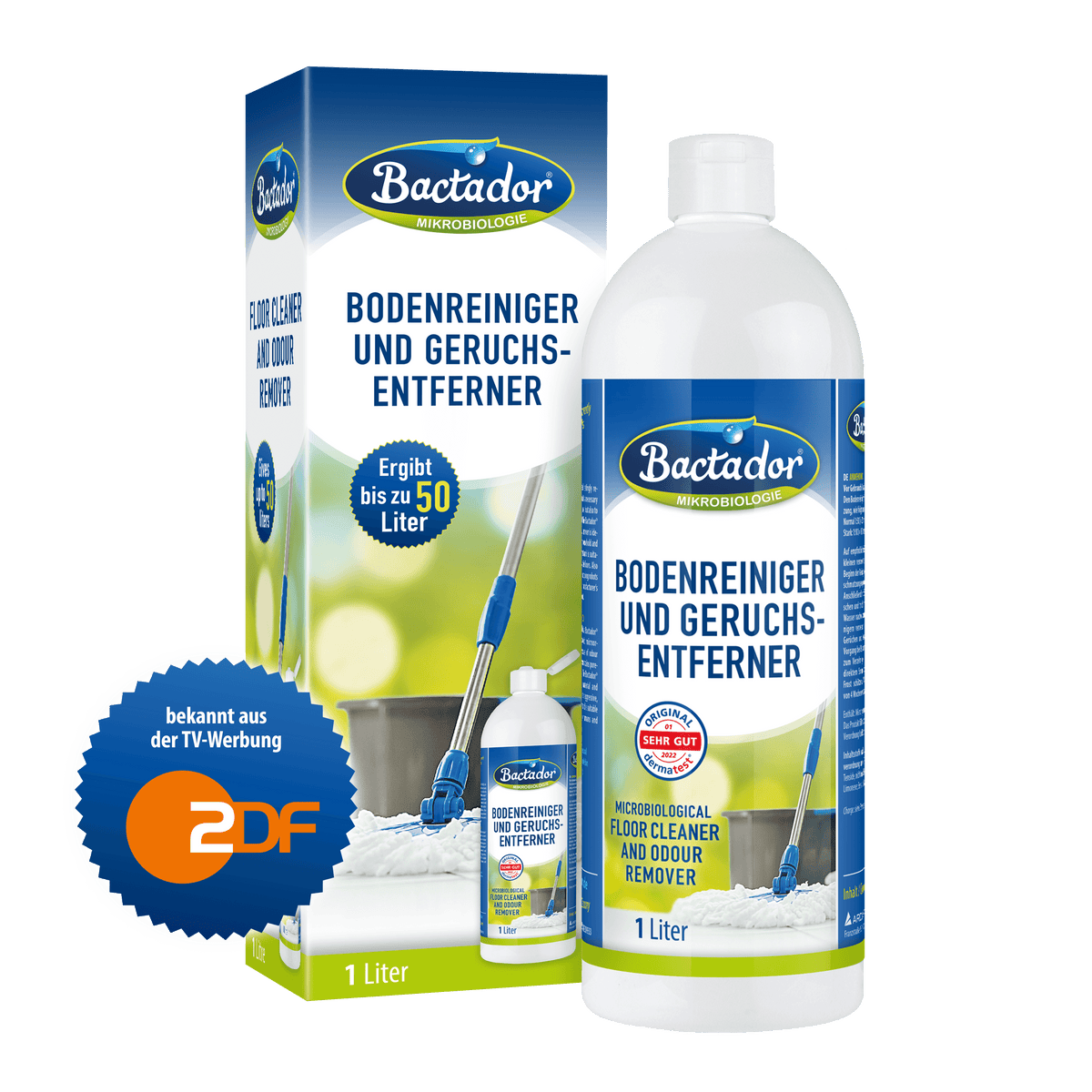
The Bactador Floor Cleaner and Odor Remover is suitable for floor cleaning. It can be easily added to the mopping water and also penetrates the joints and porous surfaces of your floor. After treatment, let the floor dry and do not dry it again immediately, so that the microbiological ingredients really have time to work.

Deep-Fiber Cleaning: Odor Removal with Every Wash
Some textiles still smell after washing. Cat beds, blankets, clothing with urine residue: This is because regular detergents do not completely break down organic odor molecules. Bactador can help here too.
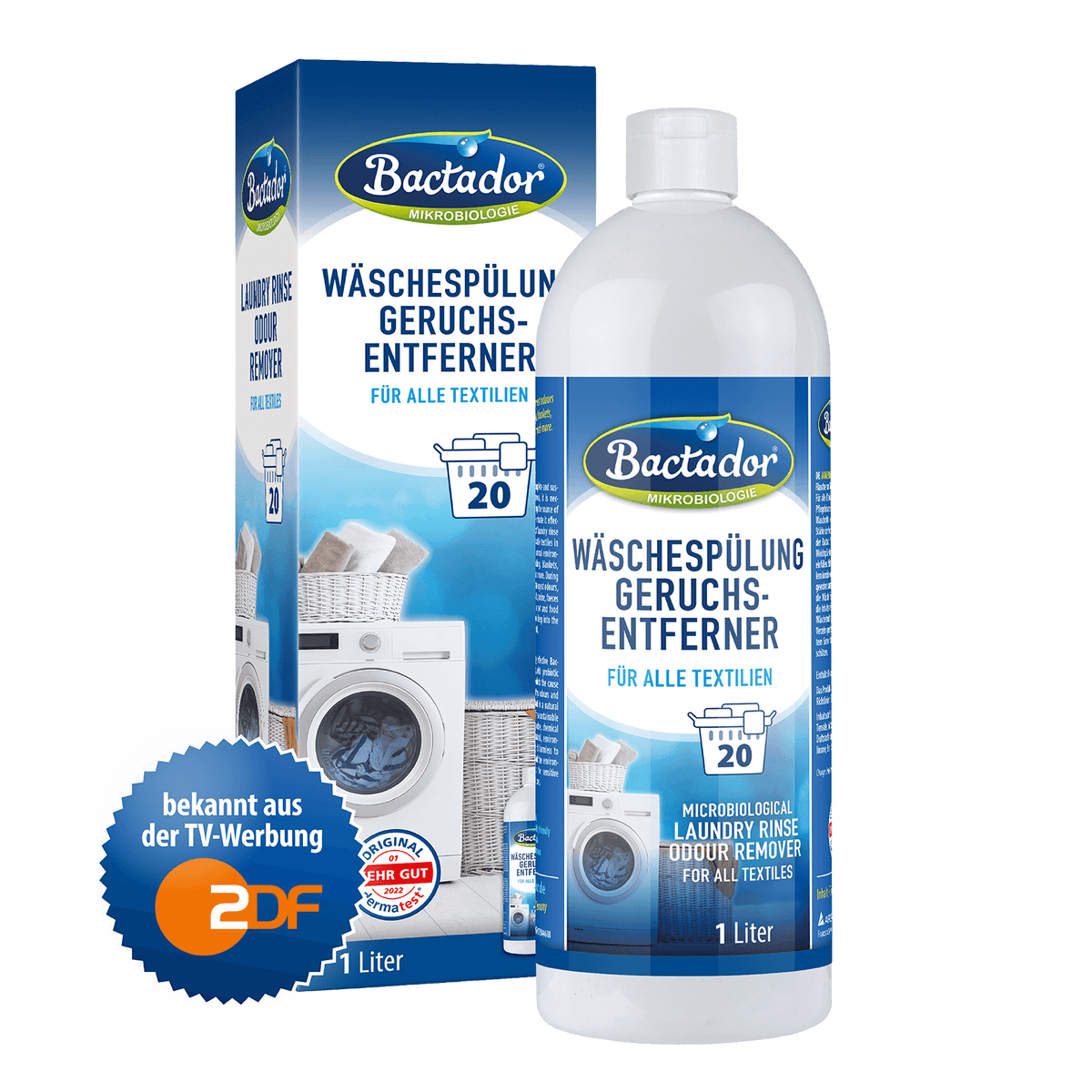
The microbiological Bactador fabric softener can simply be added to the fabric softener compartment in addition to regular detergent. It is suitable for all wash temperatures, which is particularly important for sensitive pet textiles that should often only be washed at low temperatures. After washing, you can hang the laundry up damp and let it dry completely in the air. Do not use a dryer, so that the microbiological cleaning can fully develop its effect.
“I now simply always add the Bactador fabric softener when I wash our pets' blankets or pillows. It's no extra effort, it just goes along with it. And it makes a noticeable difference: The fabrics really smell fresh and neutral afterwards.”
Conclusion
Anyone who has a cat at home knows the situation: A stain on the carpet, a penetrating odor on the cushion, and despite cleaning, the cat urine odor returns soon. Home remedies do not really solve the problem, because they do not reach the odor source deep in the fibers.
Bactador helps you exactly at this point. The natural microbiology penetrates deep into the fibers and removes the odor source where it really sits, without aggressive ingredients and gently on materials and surfaces. The microorganisms contained in Bactador are activated and produce enzymes, which break down the odor source as long as it is completely removed. This way, your home stays fresh permanently, without you having to start over again and again. For cat owners, the Bactador cat urine odor remover is therefore a real everyday helper and should not be missing from your basic equipment.
Frequently Asked Questions
How can I prevent my cat from peeing in the same place indoors again and again?
So that your cat does not return to the same place again and again, the spot must be completely odor-free, not only for the human nose, but especially for your cat's much more sensitive nose. Urine residues that humans no longer perceive can still be smelled by the cat for a long time and interpreted as an incentive for marking. The Bactador cat urine odor remover removes these deeply embedded residues deep in the fibers and permanently. In addition, it is worth checking the cat litter box situation: location, the number of toilets, and the cleanliness around them play an important role.
Does baking soda really help against the smell of cat urine?
Baking soda can bind moisture and thus superficially bind odor in the short term, but nothing more. The organic compounds in cat urine that sit deep in the fibers and pores remain unaffected. The odor source remains and the odor returns after a short time, especially in heat or humidity. For reliable removal, the Bactador cat urine odor remover is the right choice.
How long do I have to let home remedies like baking soda work?
The exposure time does not change the basic limitation of baking soda: The deeply embedded odor particles of cat urine cannot be dissolved by baking soda, no matter how long it works. For really permanent odor removal, an enzyme cleaner based on natural microbiology is recommended, such as the Bactador cat urine odor remover, which penetrates deep into the fibers and neutralizes the odor source.
What works better against cat urine: home remedies or enzyme cleaners?
Enzyme cleaners are clearly superior to home remedies when it comes to the permanent removal of cat urine odor. While home remedies may cover the odor in the short term or dilute it superficially, microbiological enzyme cleaners like Bactador work directly on the odor source: The microorganisms in Bactador produce natural enzymes that break down organic dirt and odor particles deep in the fibers and remove them permanently.
Why do home remedies for the removal of cat urine not work permanently?
Cat urine dries into uric acid crystals that settle deep in fibers, materials, and joints. This crystalline structure cannot be dissolved chemically or mechanically with simple home remedies like vinegar, baking soda, or dish soap. In addition: In humidity and heat, the crystals are reactivated and release stinking odor molecules again. That is why it often suddenly smells like cat urine again after rain or on damp, humid days. Bactador starts exactly there: The natural microbiology breaks down these organic structures deep in the fibers and removes the odor source permanently.
Can I treat cat urine on leather or natural stone with Bactador?
On all water-compatible surfaces, Bactador can be applied gently on materials and skin. On water-sensitive materials such as untreated leather or certain natural stones, Bactador should be tested beforehand on an inconspicuous spot. Since materials can react differently to moisture, a short test run on the back or a hidden area is useful.
How do I recognize old cat urine spots that I have forgotten?
With a UV blacklight flashlight, old, dried urine stains can be made visible. They fluoresce in a characteristic blue-green tone. This is particularly helpful when moving into a new apartment, after buying used furniture, or if you cannot locate a stubborn odor. Once found, the spots can be treated specifically with the Bactador cat urine odor remover.