
Our Bactador expert Lisa Peters and Prof. Dr. med. vet. Norbert Mencke explain why pet odors keep coming back and show you how to remove pet odors for good.
- Causes of pet odors in the home: Why it smells
- Removing pet odors for good: What really works
- Removing pet odors for good from different materials: How to do it
- Can you prevent pet odors? Tips for everyday life
- Conclusion
- Frequently asked questions
Pet odors in the environment are mainly caused by organic residues such as urine, feces, vomit, saliva, and pheromones, which penetrate deep into fibers, carpets, and upholstery.
These residues persist as a source of odor deep within the fibers of the materials and return again and again after the use of conventional cleaners and household remedies such as vinegar or baking soda due to humidity and heat.
Particularly stubborn cat urine contains uric acid crystals that reactivate when damp and cause the characteristic odor to constantly rise again.
Conventional cleaners and household remedies only temporarily mask pet odors.
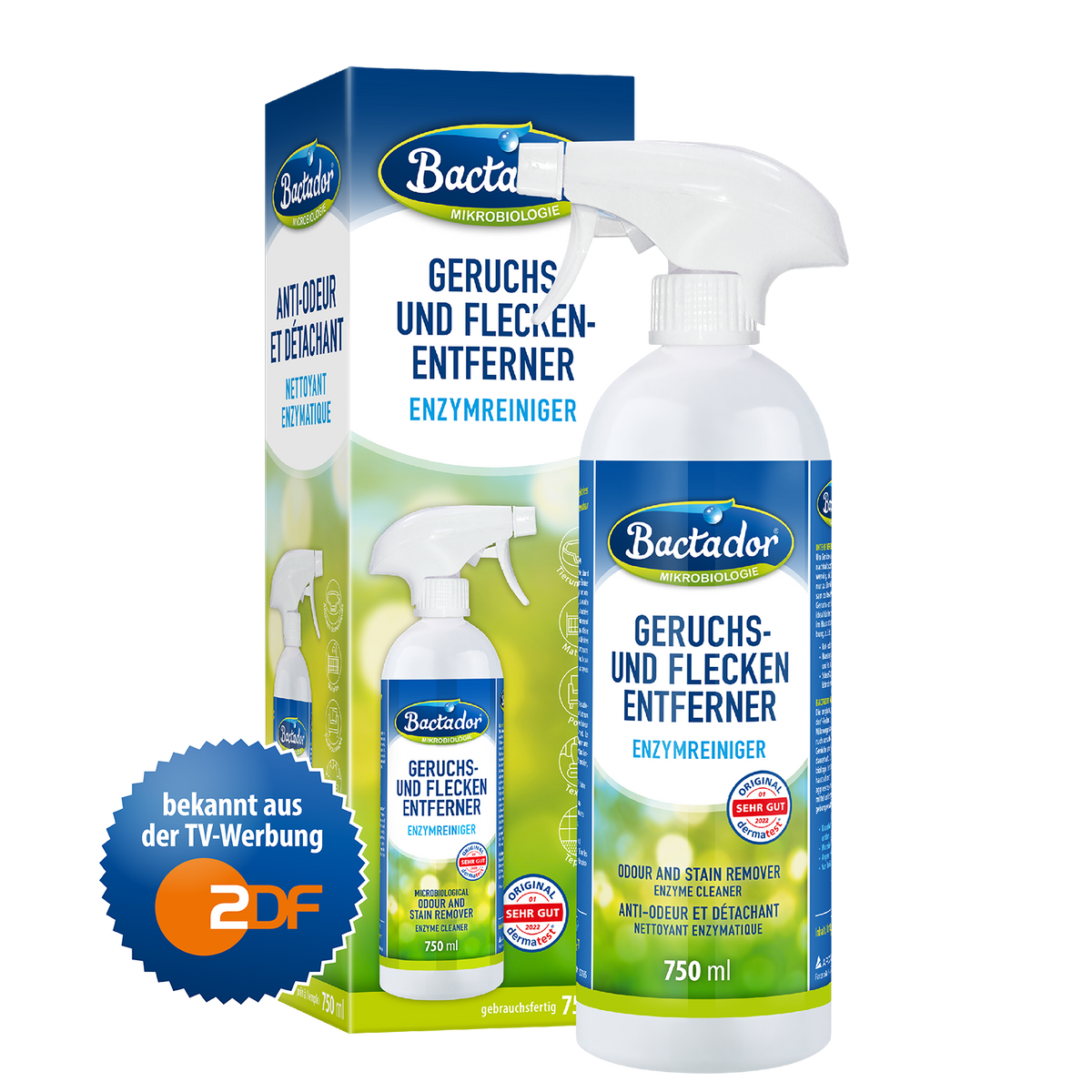
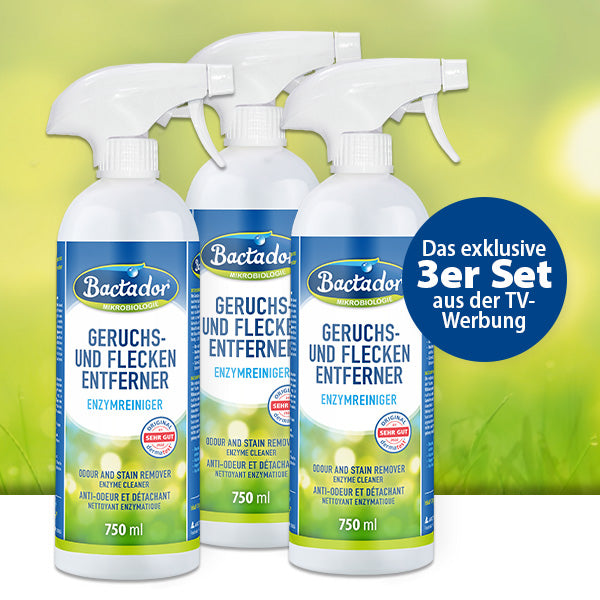
The Bactador microbiological enzyme cleaners offer a permanent solution to unpleasant pet odors.
Bactador is suitable for all water-tolerant surfaces, from carpet, upholstery, and textiles to floors and car seats, is gentle on materials and skin, and is suitable for the environment of both humans and animals.
Causes of pet odors in the home: Why it smells
It is a phenomenon that many pet owners know: You clean, ventilate, sprinkle baking soda on contaminated areas, or spray room fragrance or air fresheners. And yet, the nasty odor in the pet household is back after a short time. This is because pet odors are not merely surface problems. They are caused by organic substances such as urine, feces, vomit, saliva, sweat, and pheromones, which settle particularly deep into absorbent materials such as carpets, upholstery, blankets, and even the joints and pores of floors.
Typical sources of odor in a household with a dog or cat are urine accidents on the carpet or sofa, vomit, scent marking, and saliva residues at feeding areas, dirt and moisture from paws, as well as residues from wet fur after a walk in the rain. In addition, there are residues from the litter box as well as cage odors in rodents, which are caused by urine, feces, and damp bedding.
If these residues and odor-forming molecules are not treated quickly and, above all, thoroughly with the right enzyme cleaner, they penetrate deeper and deeper into the fibers and are reactivated again and again by humidity and heat.
Particularly urine is problematic: It contains uric acid crystals and other components that settle in the material and can also be easily reactivated. This is exactly what explains why the typical pet odor reappears even after a seemingly thorough cleaning.

“Urine components settle deep in the material and cannot be dissolved with conventional cleaners. When exposed to heat or moisture, they are reactivated and the odor returns. The area is then still perceived as marked by the dog or cat. The permanent solution for this is the Bactador enzyme cleaner.”
Every little creature has its own little pleasure: Peculiarities with different pets
Not every pet odor is the same, and for good reason. Depending on the type of animal, both the composition of the waste and the intensity of the odor differ significantly.

The “wet dog”: Why does it smell so strong?
The characteristic odor after a rainy walk is caused by odor-forming bacteria that naturally live in the dog's fur. Moisture activates the breakdown products of these bacteria and yeasts: Volatile organic compounds rise and spread through the room. Depending on the breed, coat type, and state of grooming, this odor can be stronger or weaker. The Bactador odor and stain remover spray helps to reliably remove these organic residues from upholstery, dog beds, carpets, or in the car.

Cat urine: Why does it smell so pungent?
Cat urine is one of the most intense pet odors of all. This is due to the protein-rich, meat-based diet of cats as carnivores: Their metabolism produces particularly concentrated urine with a high proportion of uric acid, creatinine, urea, and other metabolic products, as well as feline-specific odorants. These compounds are intended as communication signals for the cat's sensitive nose and are also intensely perceptible to us humans. In the case of scent marking, an increased pheromone input is added, which further intensifies the odor. Anyone who wants to remove cat urine permanently needs a cleaning that breaks down these compounds deep within the fibers. The Bactador cat urine odor remover was specially developed for this problem.
Removes extreme cat urine odor deep within the fibers and permanently
Can prevent re-marking
Enzyme cleaner for cat urine without aggressive ingredients
Rodent cages: little friends with an intense scent
Rabbits, hamsters, and other rodents produce large amounts of urine and feces in a small space. The damp bedding intensifies the odor formation, so the odor quickly spreads through the environment. Regular cleaning of the cage and the surrounding areas is therefore particularly important. The Bactador rodent cage odor remover and cleaner is specially tailored to the requirements of a rodent household and removes all resulting organic odors without residue.

Removing pet odors for good from different materials: how to do it
Anyone who wants to permanently remove pet odors caused by urine, feces, vomit, or saliva must address the cause: the organic residues that create the odor in the first place. A superficial treatment with chemical, aggressive agents or household remedies such as vinegar or baking soda is not enough and only temporarily masks the odor. Usually, it returns even more intensely after a short time.
In addition, particularly urine odor tends to return if the cleaning was incomplete. Uric acid crystals remain in the material and become active again when exposed to moisture. Above all, the sensitive noses of cats and dogs perceive the remaining odor traces and use the same spot again to mark or urinate. A complete odor removal is therefore not just a matter of well-being, but also affects the behavior of our four-legged friends.

Enzyme cleaner: Advantages of natural microbiology
The Bactador enzyme cleaner has proven particularly effective when it comes to permanently removing organic odor sources. The difference from conventional cleaners lies in the principle of action: While chemical agents mask odors like a perfume, the Bactador enzyme cleaner breaks down the odor molecules that cause the odor in the first place without residue.
Bactador goes one step further than conventional enzyme cleaners: Unlike these, which are usually based on undefined, synthetically produced enzymes, Bactador works on the basis of natural microbiology. The microorganisms contained are activated after spraying and naturally produce enzymes that specifically break down organic dirt and odor particles. This continues until the odor source is completely removed. Bactador contains no artificial or synthetic enzymes and no aggressive ingredients, is rated “very good” by Dermatest, and is recommended by veterinarians.

Bactador can be classified as part of the enzyme cleaner family, but it is much more: The formulation is based on a unique, precisely defined variety of bacterial strains that utilize the positive properties of biological microorganisms. The result is a broader spectrum of action than with simple enzyme cleaners with synthetic enzymes. The Bactador enzymes are optimized for various odors and cleaning tasks. This creates a particularly versatile, optimized, and deep-reaching cleaning.
Why household remedies are not suitable for removing pet odors
Vinegar, baking soda, or lemon juice are often recommended when it comes to combating unpleasant odors. And at first glance, these household remedies seem to work: The intense characteristic odor of vinegar temporarily masks the pet odor, baking soda absorbs moisture, lemon juice provides a temporarily fresh scent. But this is exactly where the problem lies.

“Vinegar, citric acid, or baking soda never really helped with Pepper's accidents – the odor always came back after a few days at the latest. The reason: The odor source was still deep in the carpet, I had only masked it. With Bactador it is different: spray, let dry, done.”
Household remedies do not reach the deeper layers of fibers and upholstery. The organic residues, i.e., uric acid crystals, protein compounds, and pheromones, remain in the material and reactivate when exposed to heat or moisture. The odor returns, often even more intensely than before. Vinegar can also damage sensitive fibers and colors, baking soda leaves residues and can bleach materials. Anyone who wants to truly neutralize pet odors permanently needs an odor neutralizer that breaks down the odor source deep within the fibers without residue.

Removing pet odors for good from different materials: how to do it
To remove unpleasant odors in a pet household, Bactador is suitable for a wide range of applications on all water-tolerant surfaces. Depending on the situation, there is a suitable product and a slightly different procedure. Here you will find an overview of the most common situations in a pet household.Removing pet odors from carpet, sofa, and upholstery: how to do it
Carpets, sofas, and upholstered furniture are the most frequently affected surfaces with unpleasant odors in the pet household. Urine, vomit, saliva, and the scent of wet fur quickly penetrate deep into the fibers. That is exactly where they must be treated. The Bactador odor and stain remover spray is the right choice for this.
Step-by-step instructions
- Carefully pick up coarse residues or blot liquids with kitchen paper – do not rub, so that nothing is pressed deeper into the material.
- Shake the Bactador bottle well to activate the microorganisms.
- Spray the affected area generously – also treat the edges, as odors often spread further than can be visibly seen.
- Simply let it dry. Do not wipe, rinse, or use any other cleaners, so that the microorganisms can work undisturbed.
- For particularly stubborn or old odors, the application can be repeated after drying.
Removing Pet Odors from Washable Fabrics
Washable fabrics such as dog blankets, dog jackets, cushion covers, bath towels, or stuffed animals can be cleaned particularly easily and thoroughly, eliminating extremely unpleasant odors. However, ordinary laundry detergent alone is not enough, as urine, saliva, and other organic residues can penetrate deep into the fibers and leave a residual odor after washing, sometimes even more intense than before.
The Bactador Fabric Softener is added to the fabric softener compartment in addition to ordinary laundry detergent (50 to 100 ml, depending on the level of soiling). It is suitable for all washing temperatures. After washing, you can hang the laundry up damp and let it dry completely in the open air. Avoid using a dryer so that the microbiological effect can be fully realized. Those who use Bactador regularly notice a fresher smell in the washing machine itself.
For all non-washable fabrics and upholstery (e.g., mattresses that do not fit in the washing machine), the Bactador Odor and Stain Remover Spray is suitable, as described above.

Removes odors deep within fibers permanently
Against stubborn odors (e.g., urine, feces, vomit)
Enzyme cleaner without harsh ingredients - recommended by veterinarians
Removing Pet Odors from the Car: How to Achieve a Deep Clean
The car is a particularly challenging area: car seats are made of multiple layers of material that can retain moisture and intensify odors. A wet dog on the back seat, a urine accident in the trunk, vomit, or even odors from food or nicotine: all of this can become stubbornly embedded in the vehicle interior.
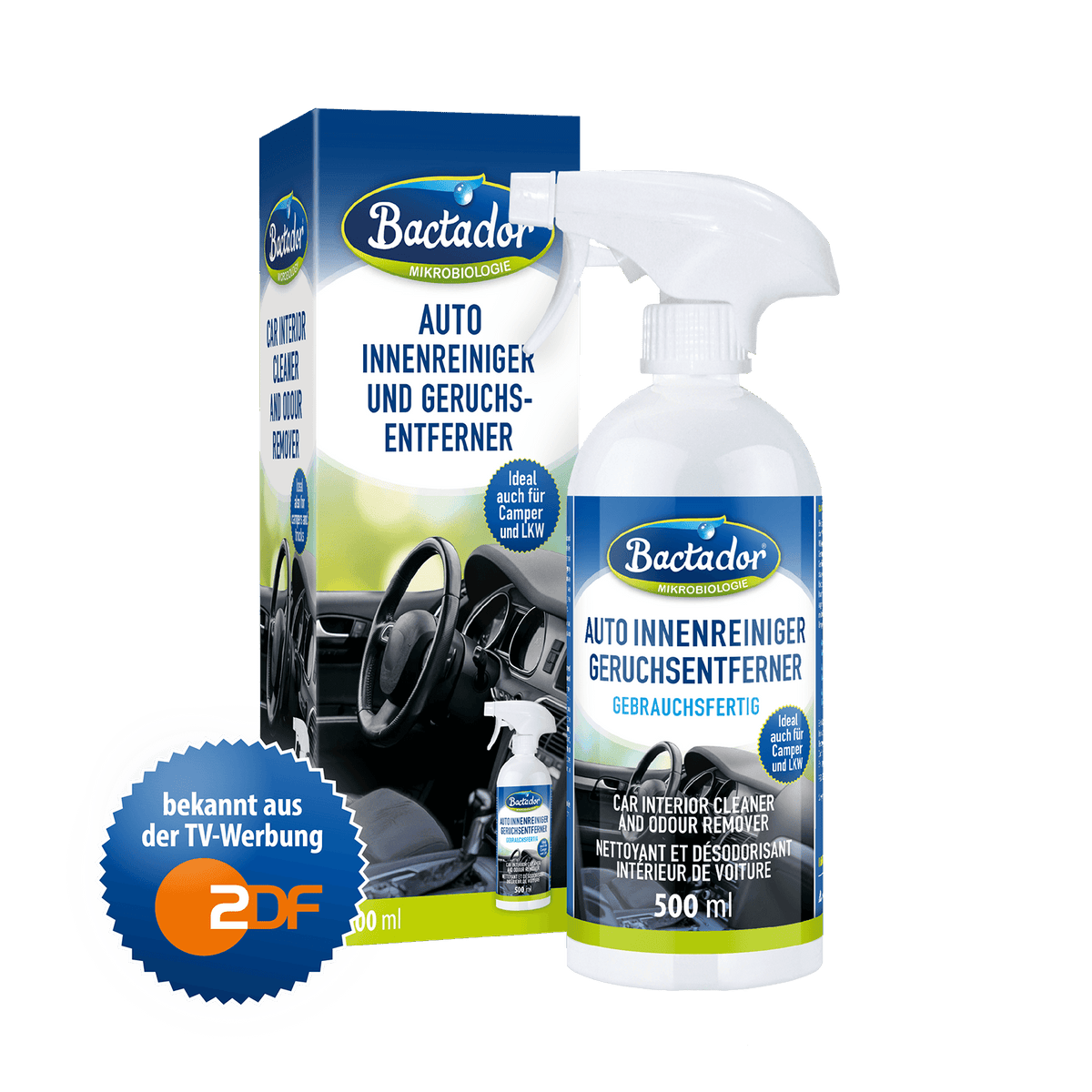
The Bactador Car Interior Cleaner and Odor Remover was specially developed for use in vehicles. It is suitable for all materials in the interior: from car rugs, blankets, and fabric upholstery to plastic, dashboards, child seats, and the vehicle headliner. After spraying, the natural microbiology penetrates deep into the fibers and permanently eliminates odor sources where they originate. The result: a fresh new-car scent throughout the entire vehicle. Particularly convenient: The spray is also suitable for cleaning the entire cockpit.

Removing Pet Odors Around the Litter Box
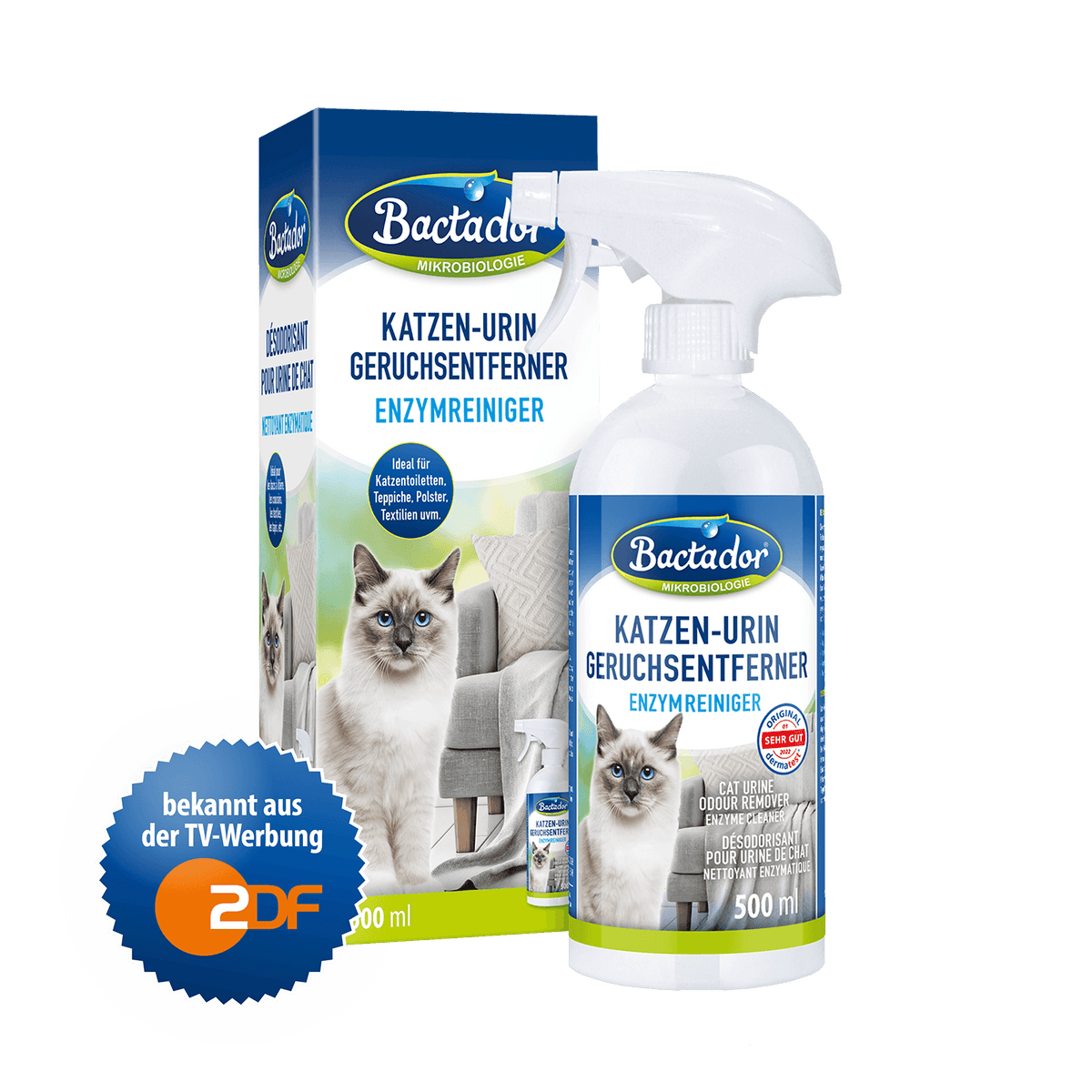
Particularly intense odors develop around the litter box, for example due to urine, feces, urine marking in the surrounding area, and urine splashes that get on the floor or wall. Normal cleaning is usually not enough, as uric acid crystals penetrate deep into joints and porous floors. The Bactador Cat Urine Odor Remover was specially developed for these particularly stubborn odor situations. It is suitable not only around the litter box, but everywhere that cat urine or urine markings need to be removed from water-soluble surfaces. It can also be sprayed on the cat litter to remove unpleasant odors there as well and keep the litter fresh longer.

Small Paws, Big Smell? How to Get Rid of Odors in the Rodent Cage
Rabbits, hamsters, guinea pigs, and others are easy-care companions whose cages can quickly develop intense odors due to urine, feces, and damp litter. The area around the cage and the floors or carpets underneath can also be affected. The Bactador Rodent Cage Odor Remover and Cleaner is specially designed for use in and around the cage. It reliably and deeply removes organic odor sources without harsh ingredients and is suitable for the environment of humans and animals.
Can Pet Odors Be Prevented? Tips for Your Daily Routine
It is almost impossible to completely prevent pet odors in the home, especially since dogs have their own characteristic scent. However, with a few simple routines, you can ensure that odors do not become intense in the first place.
- Regular basic cleaning: Vacuum carpets and floors regularly and mop them damp, for example with the Bactador Floor Cleaner or the Bactador Odor and Stain Remover Concentrate in the mopping water.
- Protect favorite spots: Washable blankets and throws on the sofa and bed catch many odors and can be easily washed, preferably with the Bactador Fabric Softener.
- Clean the litter box daily and completely change the cat litter weekly. With the Bactador Cat Urine Enzyme Cleaner, the litter stays fresh longer.
- Rinse water and food bowls daily so that no mold or odors develop.
- Cross-ventilate several times a day: Cross-ventilation works best to transport moisture and odors out of the apartment.
- Treat accidents immediately: The sooner a fresh stain from urine, feces, or vomit is treated with the Bactador Odor and Stain Remover Spray, the less deeply it penetrates the material. But Bactador is also the right choice for older odors.
- Coat care and animal hygiene: Regular coat care noticeably reduces odor development. For dogs, the Canosept Coat Care Spray for Dogs is suitable, and for cats, the Felisept Coat Care Spray for Cats. After walks, it is also helpful to dry the dog's coat and paws before they lie down on the sofa or carpet.
Tip:
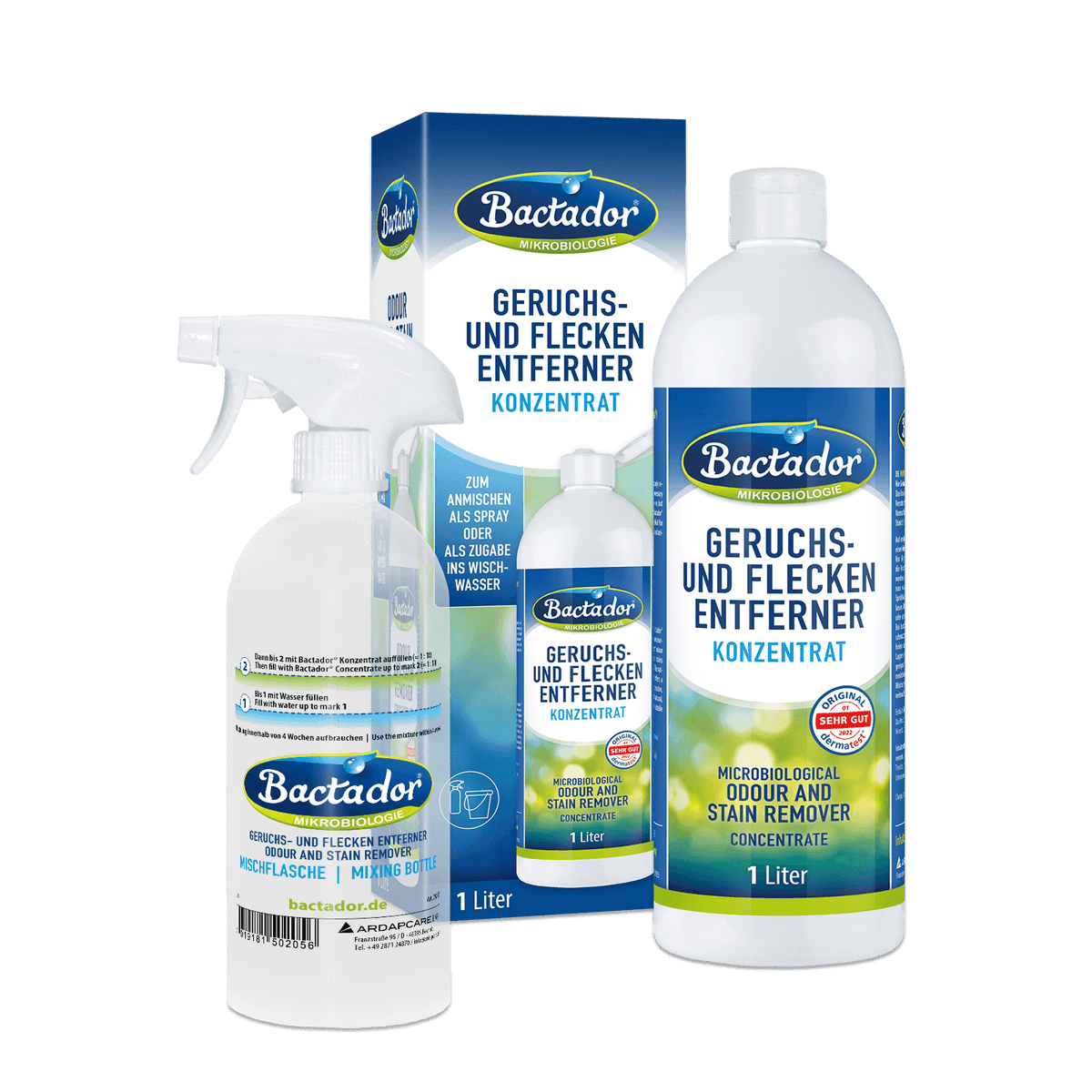
For very frequent odor problems throughout the home, the particularly economical Bactador Odor and Stain Remover Concentrate is particularly helpful. It can be used in two ways:
- Simply mix it with water in a 1:10 ratio and mop the floor with it (also suitable for robot vacuums and mops, observing the manufacturer's specifications).
- Mix it in a spray bottle and use it as a spray versatilely throughout the entire home.
Conclusion
Unpleasant pet odors, which usually arise from urine, feces, vomit, or saliva, can only be permanently removed if the odor source is eliminated at its root, i.e., deep within fibers in carpets, upholstery, fabrics, floors, and car seats. Chemical products and household remedies such as vinegar or baking soda may temporarily mask odors, but they do not reach the deeper organic residues. This is why the odor always returns, often even more intensely than before.
The microbiology of Bactador works differently. The microorganisms contained within are activated and produce natural enzymes that specifically break down dirt and odor particles as long as necessary until the odor source is completely eliminated. The result is a genuine, permanent odor removal, regardless of whether pet odors are in the home, car, on the sofa, or in fabrics. Bactador is gentle on materials and skin, suitable for the environment of humans and animals, and offers the right product for every area of the home.
Frequently Asked Questions
Why do pet odors always return?
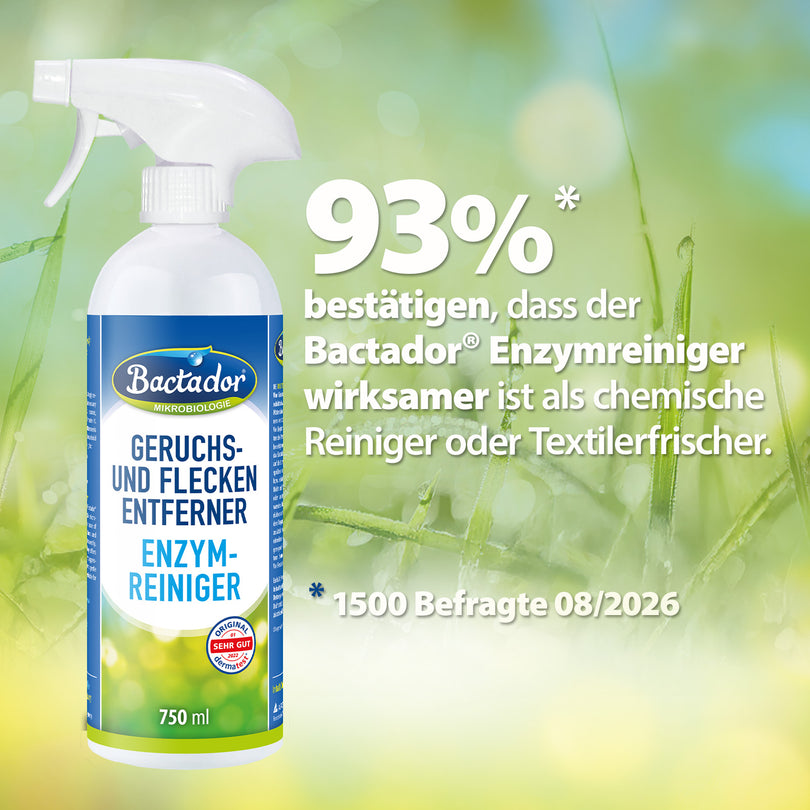
Pet odors such as urine, feces, or vomit can be particularly stubborn. If the stain is not treated with the right product and is only temporarily masked by chemical products such as fabric fresheners, the organic residues in the material are reactivated by moisture, and the unpleasant pet odor quickly returns. Household remedies such as vinegar or baking soda are also not sufficient to work long-term and deep into surfaces. To permanently and residue-free remove pet odors, numerous pet owners and veterinarians recommend the microbiological enzyme cleaners from Bactador. They eliminate the cause of the odor deep within materials, ensuring residue-free odor removal.
How often should enzyme cleaners be used for pet odors?
How often enzyme cleaners such as Bactador should be used for pet odors depends on the type and intensity of the odor. For fresh stains and accidents, a single application is often sufficient if the affected area is thoroughly dampened and given enough time to dry. For older or deeply embedded odors, a second or third application after drying may be useful. For areas where animals frequently stay, regular use of the diverse products from Bactador throughout the home is recommended.
How does the Bactador microbiology differ from chemical cleaners when removing pet odors?
The main difference between Bactador products and conventional chemical cleaners lies in the principle of action: chemical cleaning products usually only temporarily mask pet odors or merely remove them superficially. They work like a perfume. However, the actual odor source in the material remains. The Bactador microbiology is based on naturally occurring enzymes produced by activated microorganisms. These break down organic dirt and odor particles, i.e., uric acid crystals, pheromones, and protein compounds. This continues until the odor source is permanently neutralized deep within the fibers. Bactador contains no artificial or synthetic enzymes and no harsh ingredients.
Which daily practices help reduce odors in a home with animals?
In a home with animals, regular airing, frequent vacuuming, and damp mopping, for example with the Bactador Floor Cleaner or Bactador Odor and Stain Remover Concentrate, help reduce odors throughout the home. Washable blankets and covers in favorite spots catch many organic residues and can be easily cleaned with the Bactador Fabric Softener. For dogs, drying after walks and regular coat care are helpful. Litter boxes should be scooped daily and completely cleaned weekly, for which the Bactador Cat Urine Odor Remover is suitable. Accidents with feces or vomit should be treated as quickly and thoroughly as possible with an enzyme cleaner such as the Bactador Odor and Stain Remover Spray.
Are household remedies effective against pet odors in the long term?
Household remedies such as vinegar, baking soda, or baking powder are not effective against pet odors in the long term. They can temporarily mask odors or absorb moisture, but they do not reach the deeper organic residues in fibers and upholstery. Uric acid crystals, for example, remain in the material and reactivate with renewed moisture. In addition, vinegar and baking soda can damage sensitive materials or cause stains. For permanent and deep-fiber odor removal, the microbiological enzyme cleaner from Bactador is required. It is recommended by veterinarians and has been rated “very good” by Dermatest.
Does Bactador also help with old pet odors?
Bactador also helps with old and deeply embedded pet odors. Since the microorganisms contained within are activated after spraying and gradually break down organic residues, sufficient contact time and complete dampening of the affected area are particularly important. For stubborn, older odors, the application can be repeated several times after drying until the odor is completely eliminated. It is crucial that no further chemical cleaners are used after application, as these would impair the microorganisms.
Do I need to wipe surfaces again after applying Bactador?
Surfaces do not need to be wiped after applying Bactador. The treated area should simply be allowed to dry in the open air, without being rinsed or treated with another cleaner. Only in this way can the activated microorganisms fully perform their work and break down the odor particles deep within the fibers.